
Turkey Tail Mushroom UK - Why You Can't Buy It Anymore
Turkey Tail supplements have vanished from UK shelves. Here's why, and what you can still do about it.
Lloyd Jones
6/7/20265 min read
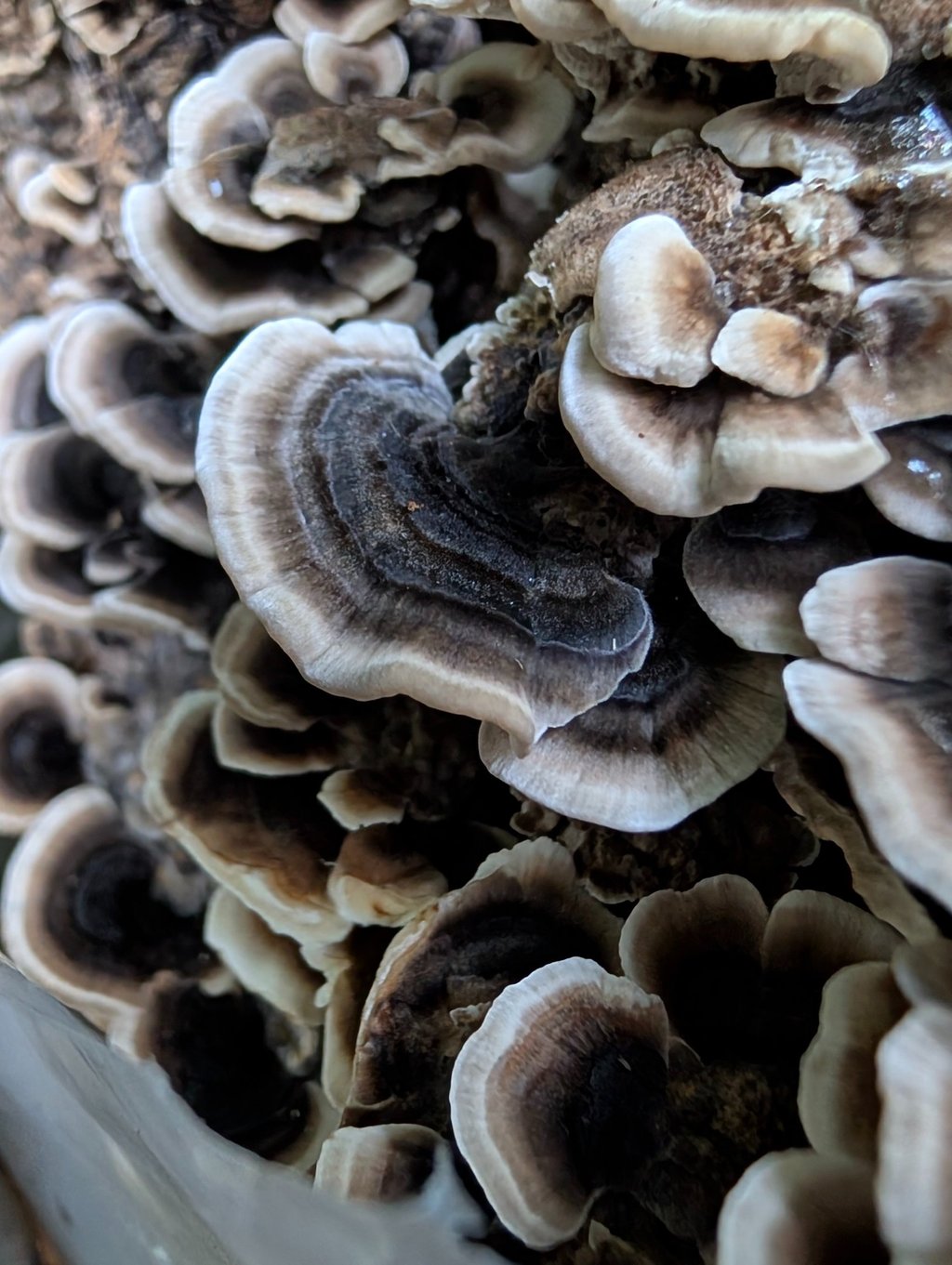
If you've recently tried to order turkey tail supplements and found them mysteriously absent from shelves, you're not imagining it. One of the most researched medicinal mushrooms in the world has effectively disappeared from the UK supplement market. Not because it's dangerous, but because of a regulatory classification that has left growers, foragers and consumers frustrated in equal measure.
Here's what's happened, what it means, and what you can still do about it.
What Is Turkey Tail?
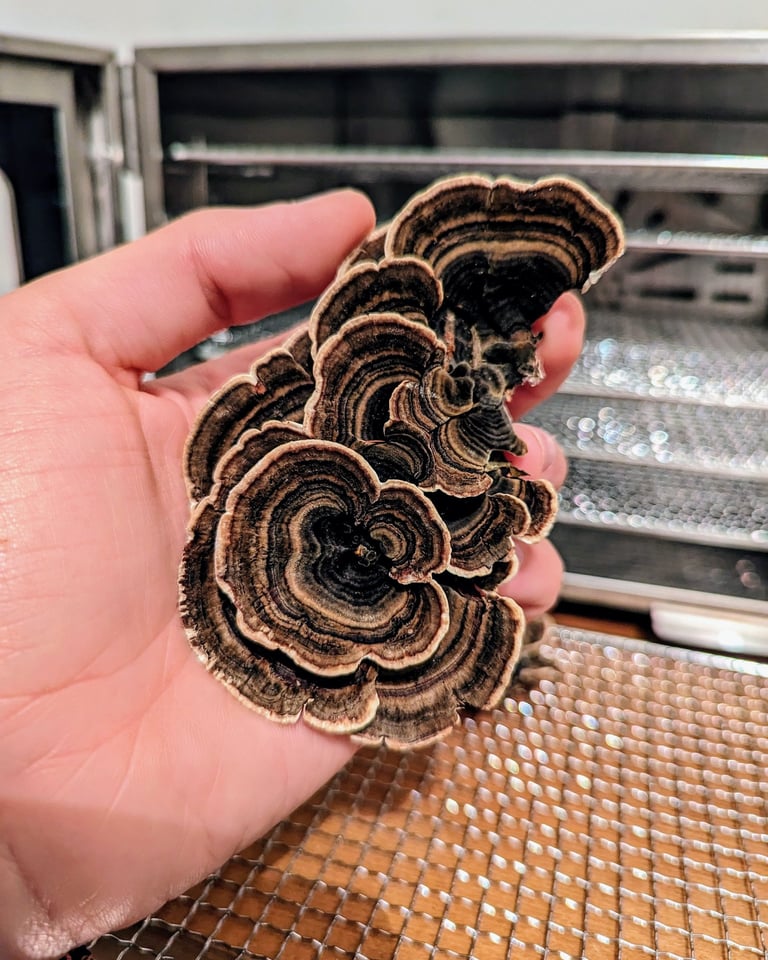
Turkey tail (Trametes versicolor) is a bracket fungus that grows on dead and decaying hardwood. It's one of the most common wild fungi in the UK. If you've ever walked through a British woodland in autumn and spotted overlapping, fan-shaped brackets in concentric bands of brown, rust, cream and white, you've almost certainly walked past it. It grows abundantly in forests across Dorset and the wider UK, including Puddletown Forest in the heart of Dorset, where I've been foraging it every autumn for years and dehydrating it for personal use.
I've also grown it myself. What I found fascinating during cultivation was watching the primordia form. The early layered pins push out from the substrate like a miniature city skyline, tight packed towers reaching upward before they know what they're becoming. Only later do they flatten and fan outward into the characteristic overlapping brackets. Something about that early stage, so different from the open flush of a lion's mane or the dramatic antlers of a Reishi, is quietly compelling. Turkey tail builds itself slowly in layers, as if it's constructing something.
It's not a culinary mushroom. The texture is leathery and tough, more like chewing on bark than anything you'd want on a plate. Its value is entirely medicinal, and that's precisely why it matters.
Why Has It Disappeared From UK Shelves?
In December 2025, the Food Standards Agency officially classified turkey tail and cordyceps as Novel Foods under UK law. This means any product containing turkey tail intended for human consumption must now go through a formal Novel Food authorisation process before it can be legally sold.
The definition of a Novel Food under UK law is any food or ingredient that was not significantly consumed in the UK or EU before 15 May 1997. The FSA's position is that turkey tail, despite its long history of use in East Asian traditional medicine, lacks documented significant consumption in Europe before that date.
The practical consequence is a de facto ban. Novel Food authorisation is an expensive, multi-year process typically only accessible to large corporations with the resources to fund it. For small UK mushroom farmers and supplement brands, compliance is essentially impossible in the near term.
Large retailers began pulling turkey tail products in early 2024. By late 2025, even small farms and independent supplement brands were required to remove their products from sale.
The Irony
Turkey tail grows wild in UK woodland. You can walk into a woods near you right now, find it on a fallen tree, take it home, dehydrate it and make a tea. Foraging for personal consumption is entirely legal.
What you cannot legally do is buy it as a supplement from a UK retailer for human consumption.
The mushroom itself hasn't changed. Its safety profile hasn't changed. The scientific evidence base for its benefits, particularly around immune modulation and its use alongside cancer treatment in Japan, where over 25% of national cancer care expenditure goes toward compounds derived from turkey tail hasn't changed either.
The classification is based purely on its documented consumption history in Europe, not on any safety concern.
What Can You Still Do?
Forage it yourself
Turkey tail is one of the most beginner friendly wild fungi to identify in the UK. The key identification markers are:
Fan-shaped or semi-circular brackets, typically 2–8cm across
Concentric multicoloured zones. Browns, rusts, creams, whites, sometimes blue-grey
Finely velvety or hairy surface
White pore surface underneath with 3–5 tiny pores per mm
Grows on dead hardwood in overlapping tiers
The main lookalike to be aware of is False Turkey Tail (Stereum ostrea) which has a smooth underside rather than pores. Check the underside — if there are no visible pores, it's not turkey tail.
Know what you pick. Never consume a wild fungus unless you are 100% certain of its identity.
What's Next?
The turkey tail situation is part of a broader conversation about how UK regulators treat traditional plant and fungal medicines. There are active petitions calling for a reversal of the classification and growing pressure from the functional mushroom industry for a more accessible authorisation pathway for small producers.
Whether that changes in the near term remains to be seen. For now, the most reliable way to access turkey tail in the UK is to go and find it yourself. Which, given that it grows abundantly in woodlands across Dorset and beyond, is not as difficult as it sounds.
Foraging Safety Disclaimer
Wild fungi identification requires care and certainty. Some species are highly toxic and can be fatal if consumed. Never eat any wild fungus unless you are completely certain of its identity. If in doubt, leave it. Consider joining a local foraging group or consulting an experienced guide before eating anything you find in the wild. The Dorset Fungus Group runs regular forays and identification events across the County.
Lloyd is the founder of Fortress Fungi Ltd, a Dorset based fungi company incorporated in 2024. He has grown many varieties of mushroom, foraged wild fungi across the UK, and researched medicinal mushroom applications for several years.
Follow the general Fungi Code:
Only pick mushrooms that have opened their caps to allow for spore dispersal
Do not pick rare or protected species
Take only what you need for personal use
Leave plenty behind for the ecosystem and other foragers
Grow it yourself
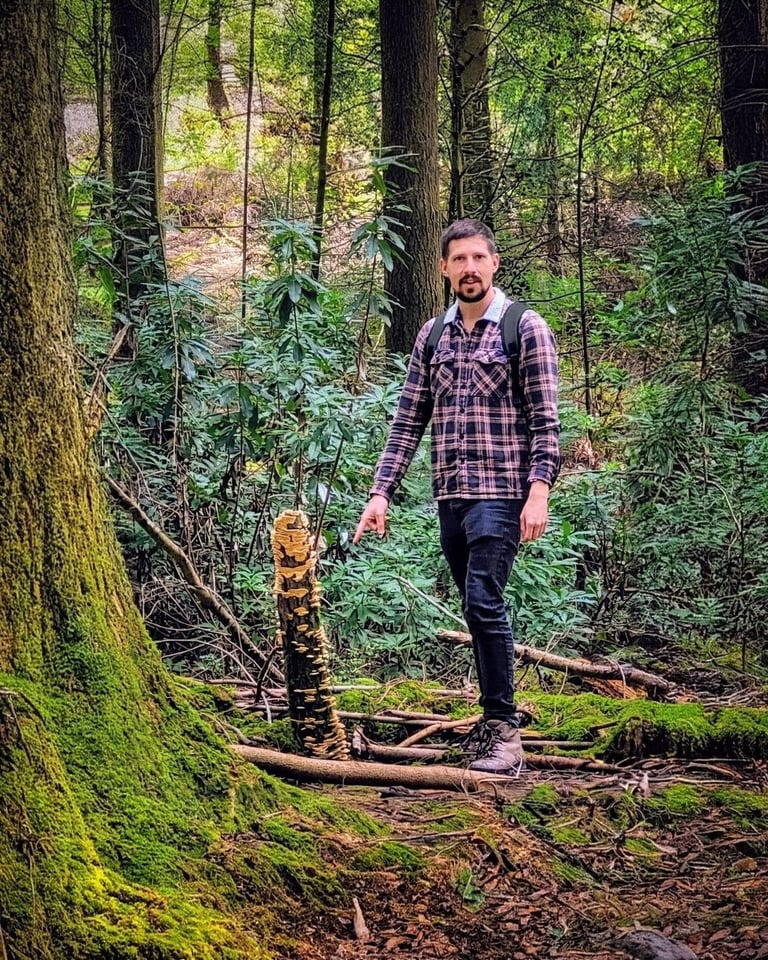
Turkey tail is one of the more straightforward medicinal mushrooms to cultivate at home on hardwood logs or sawdust substrate. I actually found it grew more readily in my garden than in a grow tent. Something about the natural environment, the ambient humidity and temperature fluctuation, seemed to suit it better than a controlled indoor setup.
Bristol Fungarium's Workaround
For those who want a UK-grown, quality-controlled product and can't forage themselves, Bristol Fungarium (one of the UK's largest organic medicinal mushroom producers) currently offers a turkey tail product for dogs. We'll leave it at that.
Pick up the Bristol Fungarium Turkey Tail for Dogs - Use code FORTRESS for 10% off
Explore
Follow us on social media to get the latest news and exclusive content.
Support
Fortress Fungi Ltd © 2024.
All rights reserved.